
At a glance
AI buildouts are absorbing the world's HBM, DRAM, and NAND supply. NFC chips are a very different class of hardware — most modern deployments barely touch the memory on the tag at all.
If you've been near tech headlines this year, you've seen the story. AI is gobbling memory. HBM, DRAM, NAND — the big players are buying everything fab lines can make, and analysts keep revising prices upward.
A fair question if you're buying NFC tags: does this matter for me? NFC chips have memory too.
Honestly, not much. And the reason is worth a few minutes because it should change how you shop.
Where NFC memory actually lives
NTAG213, NTAG215, and NTAG216 are a very different class of chip from the HBM, DRAM, and NAND memory used in AI data centers. They are low-cost NFC tag ICs used for product labels, business cards, pairing, and consumer engagement — not competing with GPU memory for fab capacity.
There's a more interesting reason the panic doesn't apply, though. Modern NFC deployments barely use the memory on the tag anyway.
The old way
Early NFC deployments wrote everything onto the chip itself. Contact details, Wi-Fi credentials, URLs, marketing copy. The more you wanted to store, the bigger the chip you had to buy.
It worked until it didn't. Phone numbers change. Websites move. Campaigns end. The tag sitting on a business card or a shelf somewhere kept serving stale data until someone reprogrammed or replaced it.
How it works now
Today the tag holds one thing: a short URL. Something like https://linqs.in/a7X9P2.
The phone reads it, the browser opens, the server looks up the ID, the latest content gets served. The tag is a key. Everything else lives on a server.
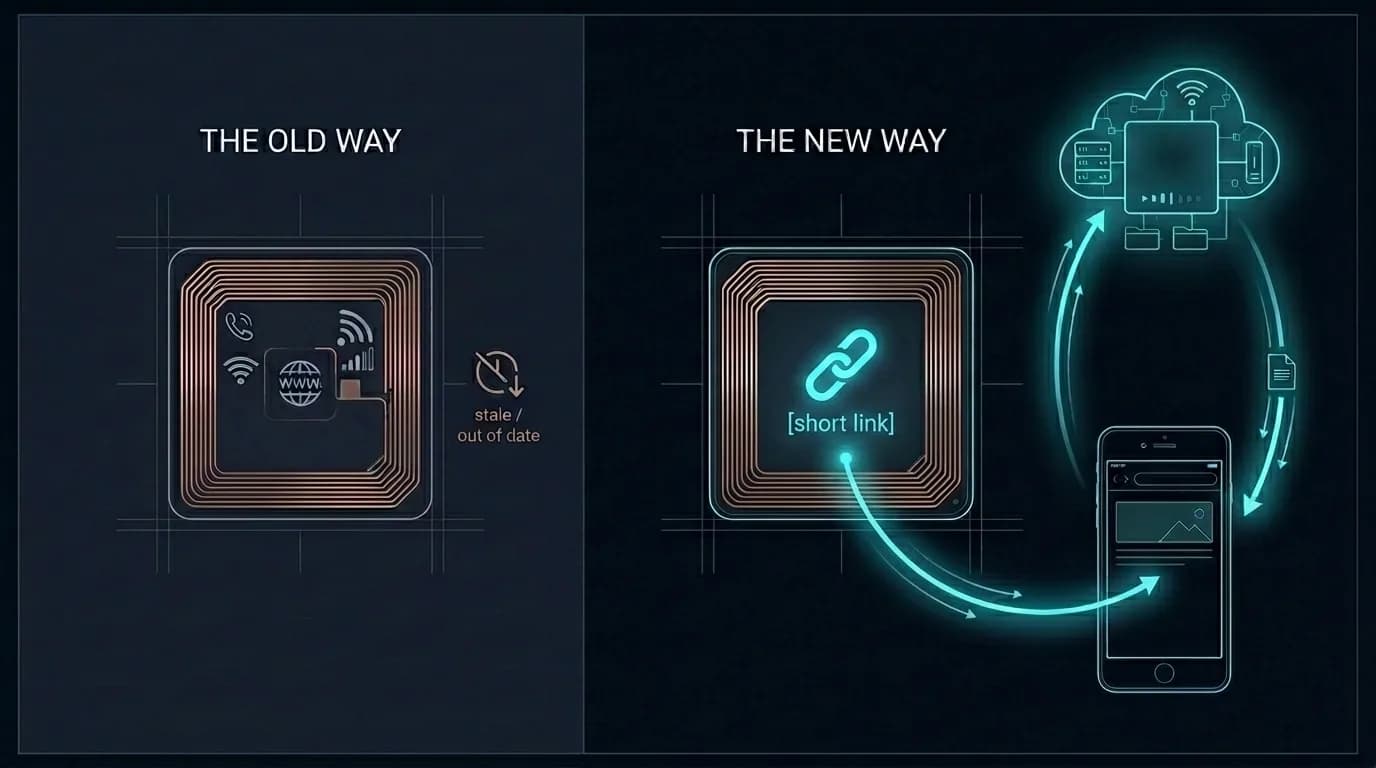
1card.in digital business cards work exactly this way. Change your job title, your phone number, your LinkedIn — you update your profile once and the card never has to be touched. The next person who taps sees the current version.
Same pattern shows up across what we ship. A revuz.in review stand tag points to whichever Google review URL you're currently using. An asset tag points to the maintenance history. A lessworry.in pet tag points to your contact details, the vet's number, and a finder flow that can route a call to you in seconds — none of which fits on a chip, and none of which should.
| Use case | Best chip | Why |
|---|---|---|
| Short URL / redirect | NTAG213 | Enough for most server-based deployments |
| Long tracked URL with parameters | NTAG215 | Safer when URLs include query strings |
| Offline vCard / contact record | NTAG215 / NTAG216 | More payload space needed |
| Complex multi-record NDEF payload | NTAG216 | Maximum 888 bytes user memory |
| Dynamic AI flow, chatbot, review, profile | NTAG213 | Tag only stores URL; server does the work |
Why this matters for what you actually buy
Once the tag is just a pointer, the choice between NTAG213, 215, and 216 stops mattering for most buyers. NTAG213 holds a short URL several times over. In practice, NDEF encoding overhead reduces usable space slightly, but a clean short URL such as linqs.in/abc123 still fits comfortably inside NTAG213. You only need NTAG215 or NTAG216 for offline vCard records, large NDEF payloads, or multi-record encoding — most buyers aren't doing any of those.
If your NFC tag opens a website, profile, review page, chatbot, pet finder page, or asset record — buy NTAG213. Buy NTAG215 or NTAG216 only when the data itself must live offline on the chip.
In practice: lower cost, easier sourcing, less anxiety about which chip family happens to be in stock this month.
Where AI actually shows up
AI does enter this picture, just not the way the headlines suggest. The richer the experience customers expect — personalized content, AI chat, dynamic recommendations — the more obvious it gets that none of this was ever going to fit on a chip.
A pet tag that opens an AI-powered chat with whoever finds your dog doesn't need more chip memory. It needs a smarter server. The tag just has to point at it.
The takeaway
Bigger tags aren't the future. Smaller tags wired to smarter systems are.
If you're buying for a deployment that needs to work for years, spend less time worrying about chip capacity and more time asking what's on the other end of the URL. Chip memory rarely matters once the tag stores only a short URL. What still matters is antenna design, surface compatibility, durability, and the quality of the system behind the URL.